
Arsenic forms a sulfide mineral with nickel called gersdorffite. Tennantite is a sulfide which contains arsenic, copper, iron and antimony. Arsenic joins with iron and cobalt in the sulfide glaucodot. Arsenic with silver forms the sulfide proustite. In the sulfide mineral hutchinsonite, (Tl, Pb) 2 As 5 S 9, arsenic joins with thallium and lead. With an atomic number 33, and atomic mass 74.92, arsenic is a notoriously poisonous metalloid with multiple allotropic forms. This write-up will tell you more Arsenic is a highly poisonous metallic element with three allotropic forms―yellow, black, and gray.
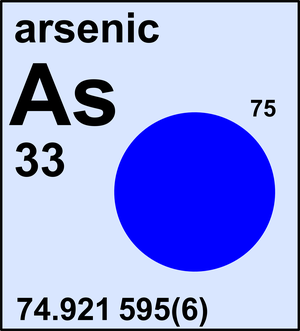
- Most commercial arsenic is recovered as a by-product of the smelting of copper, lead, cobalt, and gold ores. Only one stable isotope of arsenic, that of mass 75, occurs in nature. Among the artificial radioactive isotopes is one of mass 76, which has a half-life of 26.4 hours. Arsenic-72, -74, and -76 have been used in medical diagnostic.
- Atomic Mass of Arsenic Atomic mass of Arsenic is 74.9216 u. Note that, each element may contain more isotopes, therefore this resulting atomic mass is calculated from naturally-occuring isotopes and their abundance. The unit of measure for mass is the atomic mass unit (amu).
- Name: Arsenic Symbol: As Atomic Number: 33 Atomic Mass: 74.9216 amu Number of Protons/Electrons: 33 Number of Neutrons: 42 Date of Discovery: Known to the ancients Discoverer: Unknown Uses: Poison, conducts electricity, semiconductors Classification: Metalloid.
Arsenic is one of the most ancient element known to human history. It is very toxic and can enter the biological system through contaminated water, soil and air.

History and Discovery
Arsenic has a been known since prehistoric time and in the Bronze age it was used to make alloys with bronze. Arsenic was isolated as a distinct compound by Albertus Magnus in 1250. The word arsenic has been originated from zarnik, that means yellow or golden colored in Persian language and from Greek word arsenikon used for male. Later, the Greek word changed to arsenicum in French and finally the English word arsenic was derived from it. Arsenic has a notorious history in regard to its use as a fatal poison and was commonly termed as the poison of the kings and the king of the poisons [1].
Arsenic
| Periodic Table Classification | Group 15 Period 4 |
|---|---|
| State at 20C | Solid |
| Color | Metallic grey |
| Electron Configuration | [Ar] 3d10 4s2 4p3 |
| Electron Number | 33 |
| Proton Number | 33 |
| Electron Shell | 2, 8, 18, 5 |
| Density | 5.72 g.cm-3 at 20°C |
| Atomic number | 23 |
| Atomic Mass | 74.92 g.mol -1 |
| Electronegativity according to Pauling | 2.18 |
Occurrence
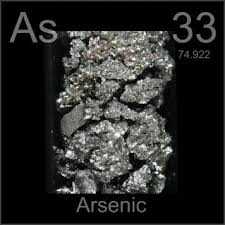
Arsenic is abundant element and occurs in about 1.5ppm of concentration in the earth’s crust. It is categorized as the 53rd most abundant element on earth. However, it is also present in minute quantities in water and atmosphere. Arsenic can exist in nature in its free elemental, as well as combined form. In combined form, it is primarily present in minerals of sulfur. There are various allotropic forms of arsenic, black, yellow and gray. The gray allotrope of arsenic is the most common and is widely used all over the world in various applications [2]. Arsenic is metabolized by some bacteria and certain animals, including goats, hamsters and chicken intake arsenic as an essential dietary nutrient. The largest producers of arsenic include China, Russia, Belgium, USA and Morocco.
Physical Characteristics
Yellow arsenic is waxy and soft. Both yellow and gray arsenic are highly volatile and unstable. They have very low density (5.727 g/cm3). Black arsenic is brittle and have a glassy appearance. It is poor conductor of electricity.
Chemical Characteristics
Arsenic Atomic Mass Number
When exposed to air it is tarnished and forms a golden-bronze layer on its surface that turns black with passage of time [3]. When arsenic is heated in air, it gives a pungent, garlic like odor as arsenic is oxidized to form arsenic trioxide. Certain compounds of arsenic undergo sublimation when exposed to high temperature, around 614 °C [3]. Arsenic reacts with various metals to form arsenides, and the most common oxidation state of arsenic in compounds is +3 and -3. There are various inorganic compounds of arsenic, including arsenic trioxide which is formed by the oxidation of arsenic in the presence of air and water. Arsenic also readily reacts with halogens to form trihalides and pentahalides, for instance arsenic pentafluoride. There are also many organic compounds of arsenic, such as cacodylic acid, which is formed by the methylation of arsenic trioxide, which is highly pungent and toxic compound.
Significance and Uses
- The use of arsenic for various products was greatly limited due to the increased knowledge of its toxicity. In 2004, an official ban was applied on the use of chromated copper arsenate (CCA) in US and Europe. CCA was widely used as wood preservative in these countries. However, arsenic is still used in other countries of the world for wood preservation and various other applications.
- Arsenic is used as a feed additive in swine and poultry industry, to improve the growth of animals.
- Arsenic is used in various medial purposes, such as drugs for treatment of infection and cancer.
- Arsenic is used to make alloys with lead to provide strength to lead batteries.
Health Hazards
Arsenic is toxic compound. Its toxicity to biological system and environment is greatly enhanced due to its water solubility. The main source of arsenic toxicity includes weathering of arsenic ores and mineral, and volcanic ash. Audio and video converter for mac. Traces of arsenic pollution have been found in air, soil and water, from where it can be inhaled and ingested [4]. arsenic water pollution has reached to an alarming level in groundwater in Bangladesh and have according to an estimate, it has affected 57 million people living that region [5].
Isotopes of Arsenic
Natural arsenic has only one stable isotope, arsenic-75 [6]. There are around 33 artificially produced isotopes of arsenic, that range in atomic mass from 60 t0 92. The most stable radioactive isotope is arsenic-73, which as a half-life of 80 days.
REFERENCES
[1]. Vahidnia, A.; Van Der Voet, G. B.; De Wolff, F. A. (2007). “Arsenic neurotoxicity – a review”. Human & Experimental Toxicology. 26 (10): 823–32. doi:1177/0960327107084539. PMID18025055.
[2]. Norman, Nicholas C. (1998). Chemistry of Arsenic, Antimony and Bismuth. Springer. p. 50. ISBN978-0-7514-0389-3.
What Is Arsenic Atomic Mass
[3]. Gokcen, N. A (1989). “The As (arsenic) system”. Bull. Alloy Phase Diagrams. 10: 11–22. doi:10.1007/BF02882166.
[4].Arsenic. The Agency for Toxic Substances and Disease Registry (2009).
[5]. Henke, Kevin R. (28 April 2009). Arsenic: Environmental Chemistry, Health Threats and Waste Treatment. p. 317. ISBN978-0-470-02758-5.
Arsenic Periodic Table Atomic Mass
[6]. Georges, Audi; Bersillon, O.; Blachot, J.; Wapstra, A. H. (2003). “The NUBASE Evaluation of Nuclear and Decay Properties”. Nuclear Physics A. Atomic Mass Data Center. 729: 3–128. Bibcode:2003NuPhA.729….3A. doi:10.1016/j.nuclphysa.2003.11.001.
Other Periodic Table Elements

- Neon
Neon is a noble gas discovered in 1898 by British chemists Morris W. Travers and…
- Caesium
Caesium, also spelt as Cesium, was discovered in 1860. It is outstanding in keeping time…
- Francium
Francium was discovered in 1939. It is very unstable alkali metal and considered the second…