
- Jupyter Notebook Install
- Heading In Jupyter Notebook
- How To Center Heading In Jupyter Notebook
- Insert Heading In Jupyter Notebook
- Heading In Jupiter Notebook
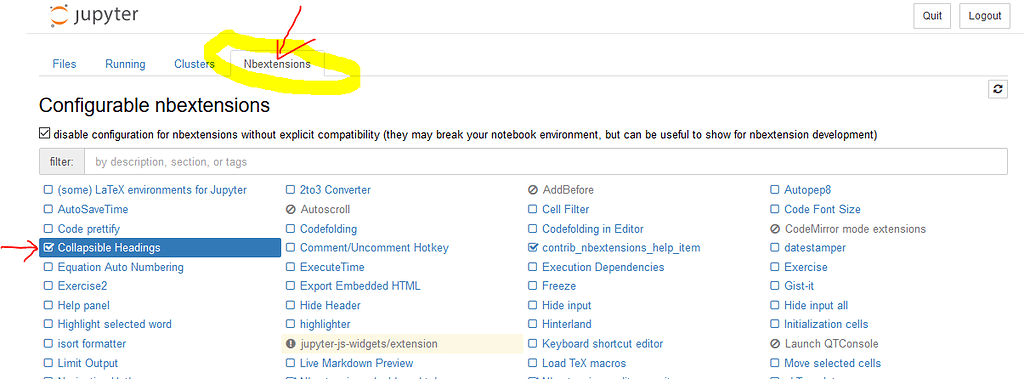
By default, heading levels are only differentiated through a different font size. I'd like jupyter to display hierarchical numbered titles so that: # Heading 1 # Heading 2 ## Sub Heading # Heading 3 would display something like: 1 Heading 1 2 Heading 2 2.1 Sub Heading 3 Heading 3. I don't get this with Jupyter 4.2.3. To write a header, include # before the text for h1 header, ## before the text for h2 header, ### before the text for h3 header, and so on. NOTE: In Jupyter notebooks, you must leave a space between the group of # signs and the text. This is not required in markdown in general, but rather it's a Jupyter notebook quirk. For example: # this is.
- Jupyter Tutorial
- IPython
- Jupyter
- QtConsole
- JupyterLab
- Jupyter Resources
Jupyter Notebook Install
- Selected Reading
Heading In Jupyter Notebook
Markdown cell displays text which can be formatted using markdown language. In order to enter a text which should not be treated as code by Notebook server, it must be first converted as markdown cell either from cell menu or by using keyboard shortcut M while in command mode. The In[] prompt before cell disappears.
Header cell
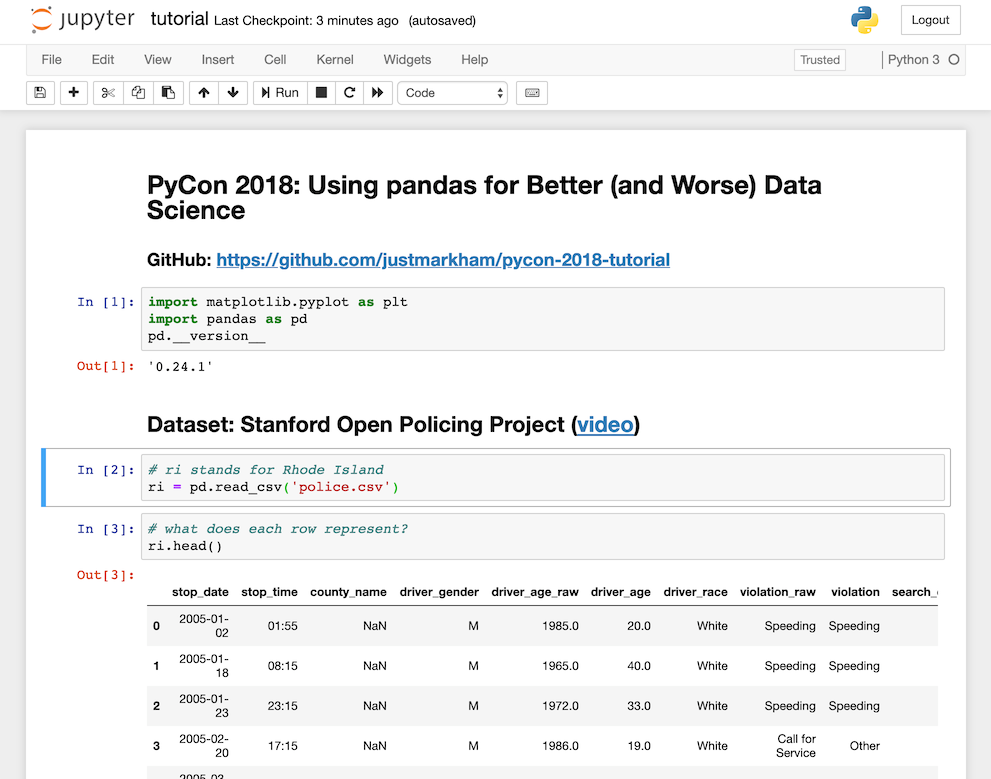
A markdown cell can display header text of 6 sizes, similar to HTML headers. Start the text in markdown cell by # symbol. Use as many # symbols corresponding to level of header you want. It means single # will render biggest header line, and six # symbols renders header of smallest font size. The rendering will take place when you run the cell either from cell menu or run button of toolbar.
Following screenshot shows markdown cells in edit mode with headers of three different levels.
When cells are run, the output is as follows −
How To Center Heading In Jupyter Notebook
Note that Jupyter notebook markdown doesn’t support WYSWYG feature. The effect of formatting will be rendered only after the markdown cell is run.
Ordered Lists
To render a numbered list as is done by <ol> tag of HTML, the First item in the list should be numbered as 1. Subsequent items may be given any number. It will be rendered serially when the markdown cell is run. To show an indented list, press tab key and start first item in each sublist with 1.
If you give the following data for markdown −
It will display the following list −
Bullet lists
Each item in the list will display a solid circle if it starts with – symbol where as solid square symbol will be displayed if list starts with * symbol. The following example explains this feature −
The rendered markdown shows up as below −
Hyperlinks
Markdown text starting with http or https automatically renders hyperlink. To attach link to text, place text in square brackets [] and link in parentheses () optionally including hovering text. Following screenshot will explain this.
The rendered markdown appears as shown below −
Bold and Italics
To show a text in bold face, put it in between double underscores or two asterisks. To show in italics, put it between single underscores or single asterisks.
The result is as shown below −
Images
To display image in a markdown cell, choose ‘Insert image’ option from Edit menu and browse to desired image file. The markdown cell shows its syntax as follows −
Image will be rendered on the notebook as shown below −
Table
In a markdown cell, a table can be constructed using | (pipe symbol) and – (dash) to mark columns and rows. Note that the symbols need not be exactly aligned while typing. It should only take respective place of column borders and row border. Notebook will automatically resize according to content. A table is constructed as shown below −
The output table will be rendered as shown below −
- Jupyter Tutorial
- IPython
- Jupyter
- QtConsole
- JupyterLab
- Jupyter Resources
- Selected Reading
While the menu bar and toolbar lets you perform various operations on notebook, it is desirable to be able to use keyboard shortcuts to perform them quickly.
Jupyter Notebooks have two different keyboard input modes −
Insert Heading In Jupyter Notebook
Command Mode − Binds the keyboard to notebook level actions. Indicated by a grey cell border with a blue left margin.
Edit Mode − When you are typing in a cell. Indicated by a green cell border.
Command Mode (press Esc to enable)
Heading In Jupiter Notebook
F | find and replace | 1 | change cell to heading 1 |
Ctrl-Shift-F | open the command palette | 2 | change cell to heading 2 |
Ctrl-Shift-P Audioscore for mac. | open the command palette | 3 | change cell to heading 3 |
Enter | enter edit mode | 4 | change cell to heading 4 |
P | open the command palette | 5 | change cell to heading 5 |
Shift-Enter | run cell, select below | 6 | change cell to heading 6 |
Ctrl-Enter | run selected cells | A | insert cell above |
Alt-Enter | run cell and insert below | B | insert cell below |
Y | change cell to code | X | cut selected cells |
M | change cell to markdown | C | copy selected cells |
R | change cell to raw | V | paste cells below |
K | select cell above | Z Ship simulators for mac. | undo cell deletion |
Up | select cell above | D,D | delete selected cells |
Down | select cell below | Shift-M | merge selected cells, or current cell with cell below if only one cell is selected |
J | select cell below | Shift-V | paste cells above |
Shift-K | extend selected cells above | L | toggle line numbers |
Shift-Up | extend selected cells above | O | toggle output of selected cells |
Shift-Down | extend selected cells below | Shift-O | toggle output scrolling of selected cells |
Shift-J | extend selected cells below | I,I | interrupt the kernel |
Ctrl-S | Save and Checkpoint | 0,0 | restart the kernel (with dialog) |
S | Save and Checkpoint | Esc | close the pager |
Shift-L | toggles line numbers in all cells, and persist the setting | Q | close the pager |
Shift-Space | scroll notebook up | Space | scroll notebook down |
Edit Mode (press Enter to enable)
Tab | code completion or indent | Ctrl-Home Download microsoft office 2016 for mac free download. | go to cell start |
Shift-Tab | tooltip | Ctrl-Up | go to cell start |
Ctrl-] | indent | Ctrl-End | go to cell end |
Ctrl-[ | dedent | Ctrl-Down | go to cell end |
Ctrl-A | select all | Ctrl-Left | go one word left |
Ctrl-Z | undo | Ctrl-Right | go one word right |
Ctrl-/ | comment | Ctrl-M | enter command mode |
Ctrl-D | delete whole line | Ctrl-Shift-F | open the command palette |
Ctrl-U | undo selection | Ctrl-Shift-P | open the command palette |
Insert | toggle overwrite flag | Esc | enter command mode |
Ctrl-Backspace | delete word before | Ctrl-Y | redo |
Ctrl-Delete | delete word after | Alt-U | redo selection |
Shift-Enter | run cell, select below | Ctrl-Shift-Minus | split cell at cursor |
Ctrl-Enter | run selected cells | Down | move cursor down |
Alt-Enter | run cell and insert below | Up | move cursor up |
Ctrl-S | Save and Checkpoint |