
Firefox User Agent Strings Firefox Click on any string to get more details Firefox 77.0. Mozilla/5.0 (Windows NT 6.1; WOW64; rv:77.0) Gecko/20190101 Firefox/77.0. User agents are the strings of text which specify the browser and operating system of web servers. User agents are present in HTTP headers when the browser wants to communicate with a server. Each browser has its specific user agent string and web servers utilize this information to deliver appropriate material across different operating systems. The User-Agent request header is a characteristic string that lets servers and network peers identify the application, operating system, vendor, and/or version of the requesting user agent. Please read Browser detection using the user agent for why serving different Web pages or services to different browsers is usually a bad idea.
A user agent tells websites what type of browser and operating system you're using. This information helps the web server deliver content that's compatible with your browser. If websites tell you that your browser is outdated or incompatible even though Firefox is up to date, an incorrect user agent may be the cause. This article explains how to fix problems with your Firefox user agent so that websites work properly.
Table of Contents


User Agent Firefox Linux
You can change Firefox's user agent to trick websites into thinking that you're using a different browser or operating system. Web developers might do this to see how their websites will appear on different systems and browsers. Sometimes, add-ons and other installations can change your user agent without your knowledge.
Websites may not display correctly or may show a message that your browser is outdated or incompatible, based on the detected user agent. It's important to switch Firefox back to the default user agent so that websites work properly.
To view your user agent, click the Firefox menu button , click Help and select Troubleshooting InformationMore Troubleshooting Information. This will open a page with the address about:support. The Application Basics section will show your current Firefox version and will include a User Agent entry. For example, the default user agent entry for Firefox 83 on Windows 10 (64-bit) would appear as:
Mozilla/5.0 (Windows NT 10.0; Win64; x64; rv:83.0) Gecko/20100101 Firefox/83.0
Sites such as What is my user agent? - WhatIsMyBrowser.com and What's my user agent? - whatsmyua.info can also show you the user agent detected by websites.
Add-ons such as the User-Agent Switcher extension can change the user agent that websites detect. See if you can restore the default user agent in your extension settings. You can also temporarily restart Firefox with all add-ons disabled (see Diagnose Firefox issues using Troubleshoot Mode for details) and, if the problem goes away, disable or remove any add-on you think may be the cause. If you can't resolve the problem this way, follow the steps below to reset the default user agent.
You can reset your user agent as follows:
- Type about:config in the address bar and press EnterReturn.
A warning page may appear. Click to go to the about:config page. - Search for useragent by typing it into the Search field.
- Right-clickHold down the control key while you click on each of these preferences, if they exist, and select Reset from the context menu.
- Type about:config in the address bar and press EnterReturn.
A warning page may appear. Click to go to the about:config page. - Search for useragent by typing it into the Search preference name field.
- Click the Reset or Delete button on each of these preferences, if they exist:

- general.useragent.extra.firefox
- general.useragent.extra.productName - where productName can be the name of some third party software (e.g. microsoftdotnet).
- general.useragent.locale
- general.useragent.override
- general.useragent.security
See Configuration Editor for Firefox for more information about using the about:config page to reset or delete preferences.
After resetting your user agent, you may need restart Firefox and clear your cookies and cache:
- Click on the menu button to open the menu panel.Click the Library button on your toolbar. (If you don't see it there, click the menu button then click Library.)
- Click History and select Clear Recent History….
- In the Time Range to clear: drop-down, select Everything.
- Below the drop-down menu, select both Cookies and Cache. Make sure other items you want to keep are not selected.
- Click .
Changing your user agent in Firefox takes a few simple steps.
Latest Firefox User Agent
Open a new tab
While Firefox has a standard settings interface for changing common settings, the interface for changing advanced settings such as the user agent in Firefox is done via the browser itself. Please open a blank window or tab.
Browse to 'about:config'
In the address bar, type in about:config and press the 'Go' arrow
Dismiss the warning
The 'about:config' system will give you access to change special settings which might make your Firefox unusable or behave strangely. Firefox will give you a warning about this to make you aware of it.
As long as you follow the instructions here, you should be fine.
Create a new preference item
Firefox's settings are stored as a series of Preference Names and Values. The initial display of 'about:config' will show you the hundreds of settings which Firefox is using. You can scroll through them to have a look if you're curious. Just be careful to not change anything unintentionally!
The setting to change your user agent doesn't exist in a default installation of Firefox; you need to create it yourself.
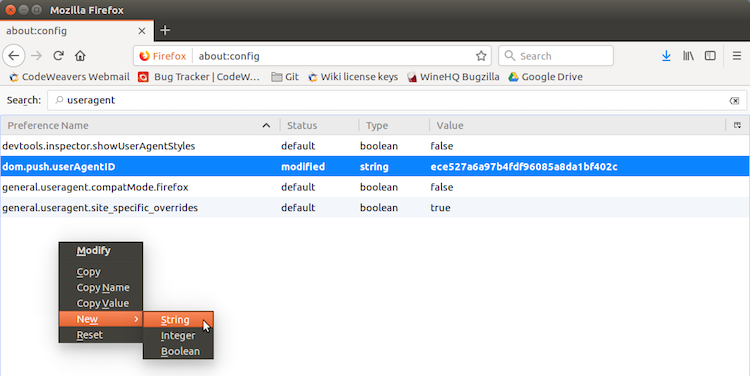
To do that, you can Right-Click any where on the list of preferences and go to the 'New' item which will be in the menu that appears. The 'New' menu item then expands to show you three options: 'String', 'Integer' and 'Boolean'.
Create a new 'String' preference by clicking on it.
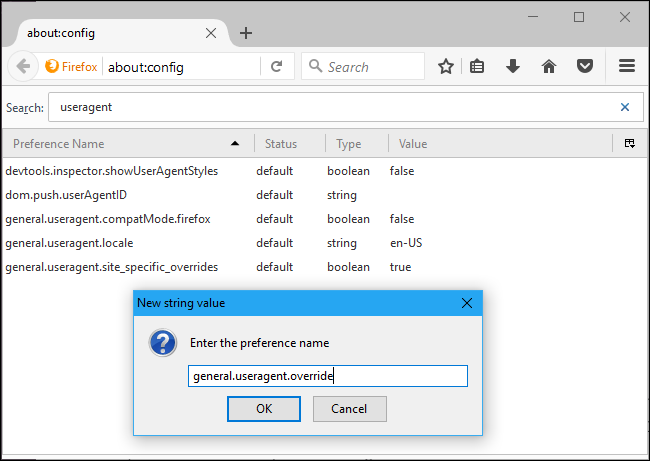
Firefox will ask you for the new Preference name: enter general.useragent.override and Press 'OK'
You are then prompted for the user agent value you want to use. You can paste or type in whatever user agent you need to use. (If you're just curious to try out user agents, you can browse our listing of user agents to find different ones to try out!)
Once you've entered your desired user agent string, press 'OK' again. Firefox will now use that user agent when you make requests.
You can test out your new user agent by visiting our homepage and setting what we detect it as!
Close the Preferences window
Now that you have selected your default browser for macOS, you can close the Preferences window (by clicking the red dot in the top-left corner) and resume your web browsing.
Resetting your user agent in Firefox
Firefox will continue to use the user agent you've set until you delete the preference you've created.
To do that, search for the general.useragent.override preference in the 'about:config' window; if you've still got the preference in your system, it will appear, displaying what you've changed it to. If it doesn't appear then Firefox presumably isn't overriding your user agent any more. Double check what Firefox is sending as your user agent. Maybe the setting has already been reset?
Once you have found the preference that is overriding your user agent, get rid of it by Right-Clicking on it and selecting 'Reset'.
The preference item will still stay there but it will no longer be bolded, the value column will be emptied. Your user agent is now reset back to it's default firefox user agent. The next time you start Firefox it will disappear completely.
You have now changed (or reset!) your user agent string in Firefox. We hope this guide was useful.
If you need to parse user agents in your system, please check out our User Agent Parsing API. It will make your life much easier!